Monday, 26 September 2016

Autumn Bounty for Riverside Wildlife


OUR AIM IS TO PROTECT OUR NATURAL ENVIRONMENT AND THE HABITAT IT PROVIDES FOR WILDLIFE ALONG THE RIVERSIDE

To find Nature Notes and records for wildlife here - click on


Our meet on Sunday 25th September 2016 started under cloudy skies after early rain, enough to increase the river level and flow for a short while but not enough to soak into the dry ground under the trees. The clouds soon moved off and it became very warm in the sun. Shade brambles were full of blackberries, larger than those produced by brambles exposed to the summer sun where berries quickly dried up. These were quickly pounced upon by blackbirds which could be detected working their way through the deep undergrowth inside bramble patches, rustling vegetation and giving quiet calls. Now, these autumn berries are providing food for many more creatures along the river, the sugars attracting insects, including late butterflies, small mammals and most birds. Seed-eaters are provided with a huge choice  and will leave seeding blackberries for later, when food is scarce, and the ground under snow. Then larger birds will land on and shake off snow covering brambles to reveal blackberries gone to seed - but still a good source of food, together with seeding Dock, left standing - a feast for goldfinches, linnets and many others searching the bare winter landscape.

LIFELINE
Recent years and months have seen a huge reduction in species-rich hedgerows that used to sustain many thousands of birds and small mammals in the surrounding countryside. Now we have a serious task in protecting existing habitat and creating more diversity in order to sustain wildlife. Replacing habitat, like for like, is scheduled to take place but will take time - meanwhile the river course, with its string of new drainage basins and ponds becomes a lifeline, literally, for all species of displaced and resident wildlife and can attract new species too.

Be watchful and vigilant...


Monday, 22 August 2016

The Height of Summer


OUR  AIM  IS  TO  PROTECT  OUR  NATURAL  ENVIRONMENT  AND  THE  HABITAT IT  PROVIDES  FOR  WILDLIFE  ALONG  THE  RIVERSIDE

To find Nature Notes and records for Wildlife here, click on


Our Group Meet was held yesterday - Sunday 21st August 2016 -  on an overcast morning which turned brighter in the afternoon. Torrential rain showers the day before brought much needed water to this years young plants  and for now we have escaped the task of watering them.
Birds which had been silent for several weeks are now starting to sing again, with robins trying out short songs in chosen territories along the river banks. They will be singing strongly by the time of our next meet on 25th September - and won't be singing alone.


Wild Honeysuckle climbing across the old post and rail fencing 
twining around itself to reach new heights and spread its scent
across the field on warm days and evenings.
Moths are attracted to it and pollinate the flowers so that birds such as bullfinches, thrushes and warblers can forage on the berries later on. Some butterfly larvae eat the leaves and long-tongued bees such as Bombus hortorum (Garden bumblebee) and Bombus pascuorum (Common Carder bee) feed on the nectar - thus the plant is beneficial to a good range of wildlife - including bats on warm evenings - prospecting for plentiful insect life.

Tuesday, 2 August 2016

A Fine Day for Wildlife

OUR AIM IS TO PROTECT OUR NATURAL ENVIRONMENT AND THE HABITAT IT PROVIDES FOR WILDLIFE ALONG THE RIVERSIDE

To find Nature Note and records for Wildlife, click on


Our meet on 31st July 2016 was a special day,  being fine and warm the whole day, with only a slight breeze. A spell of warm weather usually means more work for us in clearing rubbish left by a few fair-weather joggers and cyclists - and others who only dare to venture outdoors when the sun shines, unfamiliar with the Countryside Code!
However wild flowers were flourishing everywhere and although most birds were in moult, hiding silent and out of sight in the undergrowth, butterflies were now on the wing, with some dragonflies too.
The damp cloudy weather of the past two months had encouraged green plant growth but now a very good variety of wildflowers were forging ahead in the marshy floodplain areas and on the dry banks, providing sustenance for butterflies and bees.


 Common Fleabane (Pulicaria dysenterica) a good nectar source for at least 18 species of butterfly and is a target for many bees. Easily overlooked as 'just another daisy' the flowers have a unique shape and their dazzlingly bright yellow light attracts insects. The leaves are soft and downy - it's a plant of wet meadows, riversides and ditches. 
Here a bee is busy feeding, working its way around.

Sunday, 24 July 2016

June - waiting for summer to appear

OUR AIM IS TO PROTECT OUR NATURAL ENVIRONMENT AND THE HABITAT IT PROVIDES FOR WILDLIFE ON THE RIVERSIDE

To find Nature Notes and records for Wildlife click on
Hills Farm Wildlife Conservation


The day of our meet on Sunday 26th June 2016 was no different from previous days in June - overcast and humid but the rain held off until later. 
Ideal conditions for the growth of grasses meant that some time was spent walking around each young tree planted, cutting growth on the ground around a 1 meter radius from each trunk again to reveal the original mulch. All except one tree in an area where a bird was seen flying down into the long grass. This could wait, just in case there was a nest, or fledglings hiding out of sight until strong enough to fly.
The weather had been good for aphids and some were seen on the most exposed trees where
these were unprotected, in areas of short cut grass.
Birds such as blue tits pick off the aphids which provide rich food for their chicks but other predators had moved in - 7 Spot Ladybirds - far more than usual, on twigs close to the aphids. Their larva are voracious feeders on aphids and can clear a plant in no time, as we have seen.
Aphids can damage leaves of course but once cleared by ladybird larva and birds, the plant recovers and produces fresh new leaves. The Ladybird itself is protected from predation by its colour, red indicating danger - bitter taste and foul fluid produced when attacked.   


A 7 - spot Ladybird (Coccinella 7-punctata) on a riverbank Bramble leaf - probably ready to fly off to a nearby fruit tree


Bramble flower (Rubus fruiticosus)  on a a plant growing in dappled shade - these often are a deeper pink than those growing on very sunny banks, flower later and produce larger fruit where the soil remains damp. 

Brambles and Ladybirds, two of the most valuable occupants of the riverside and the whole countryside - we are lucky to have them and owe them our protection!


Tuesday, 14 June 2016

Great Spotted Woodpecker drums whilst we work

OUR AIM IS TO PROTECT OUR NATURAL ENVIRONMENT AND THE HABITAT IT PROVIDES FOR WILDLIFE ALONG THE RIVERSIDE

Sunday May 22nd 2016  was mostly overcast and becoming warmer. Whilst we worked, a great spotted woodpecker could be heard drumming, which is rather late, as they are usually heard in early spring but this year they have been heard drumming even more recently, in June. 
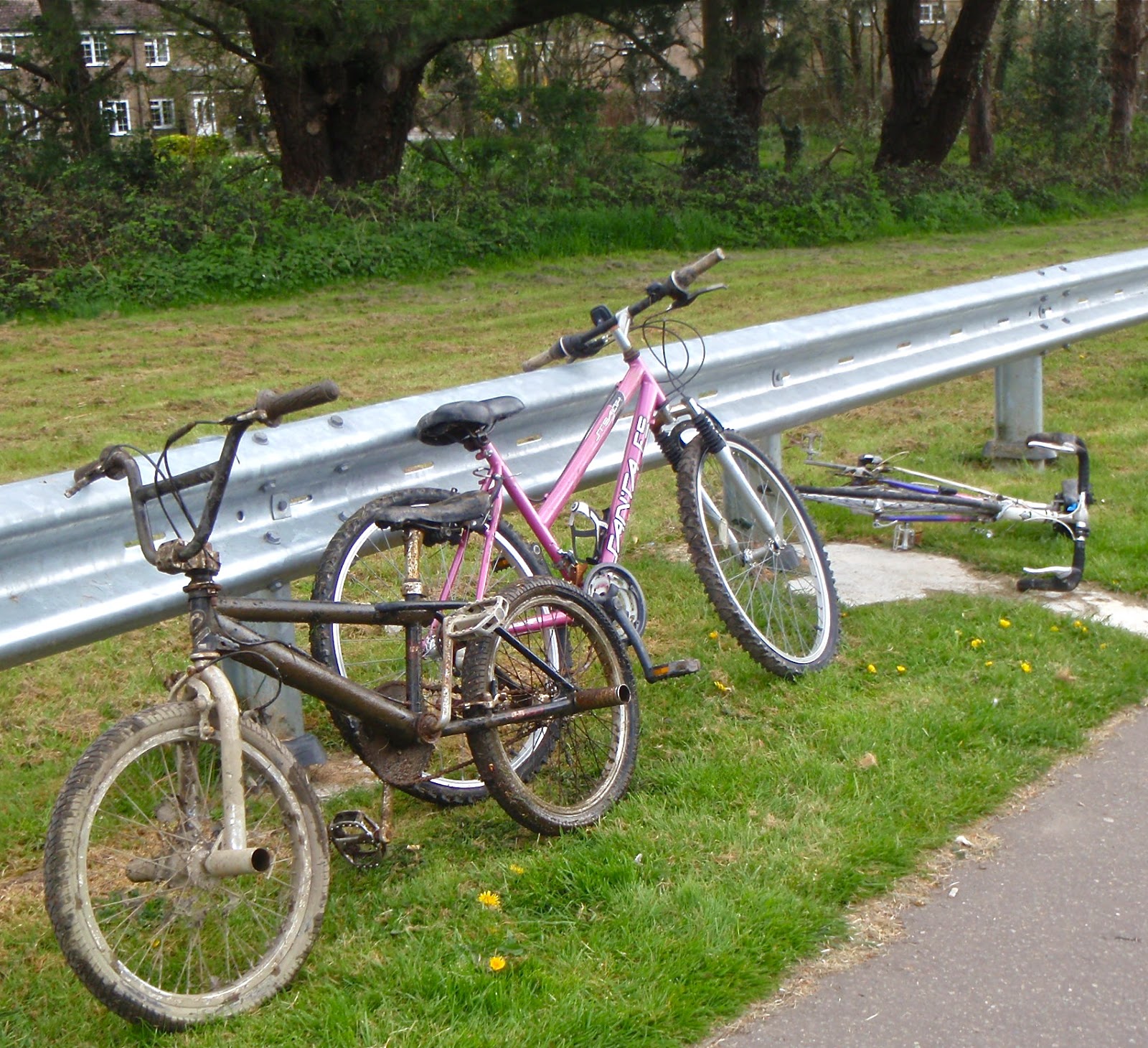
We added another bicycle to our total haul today, found in the river Arun. Our planting is growing fast after near perfect growing weather of frequent showers and intermittent warm sunny days.


Herb Bennet (Geum urbanum) growing well along the river banks and verges.
A member of the rose family, it usually grows in shady places. The name comes from herba benedicta and has been recorded since Roman times as a beneficial herb.

Two days before our meet , on 20th May, several Beautiful Demoiselle damselflies were seen on the nettles, together with large numbers of flying insects over the river. There were a few Orange Tip butterflies, a Brimstone and Holly Blues, some flying high up in the trees. Birds were singing loudly, blackcaps, garden warbler, song thrush, robins, wrens, blackbirds and chiffchaffs. Many birds were seen crossing the river back and forth, flying low- obviously feeding young on the banks - but others such as blue tits and great tits were foraging high in the oak canopies - and a great spotted woodpecker flying over.


Tuesday, 26 April 2016

April - Winter or Spring?

OUR  AIM  IS  TO  PROTECT  OUR NATURAL  ENVIRONMENT  AND  THE  HABITAT  IT PROVIDES  FOR  WILDLIFE  ALONG  THE  RIVERSIDE

There was plenty to do on our Meet on Sunday 24th April 2016 enduring weather typical of recent days - a cold northerly wind threatening rain or even sleet. 
After our previous meet on 20th March ('the first day of Spring') there was a brief spell of warm and dry weather before 'Storm Katie' raged across the landscape on 26th and 27th, with the riverside flooded as usual after such weather on 28th (see previous entry). Our new planting had been inundated but survived well and our Woodcrete bird boxes, installed on 24th withstood the storm winds too.
Since then the weather has alternated between the seasons, with wintery weather winning the battle.
Compared with the same time last year, the appearance of welcoming wild flowers and blossom has started later but is now prolific, with wild flowers carpeting the banks, more so than last year, thriving in the very damp earth.


Masses of Lesser Celandine flowering on the banks - new to this area.

Numbers of wrecked and abandoned bicycles have increased too - and three were found on the banks on Sunday:


Three wrecked bicycles retrieved.


Another task -
 After checking over several days that no nesting birds were present in and near the area, 
we took a close look at
the invasive species Himalayan Balsam which had appeared in some isolated patches on the low banks of the river Arun, the seedlings just starting to grow:


A patch of Himalayan Balsam seedlings freshly germinated -
most with just the basal leaves visible. Even at this early stage they can be distinguished from good native wild plant seedlings and can be removed: 


Usually crowded together, easy to uproot
with greyish-green leaves and stems tinged red-purple 


If the weather warms up these will be growing fast -
 to over a meter tall and start flowering - by then it's too late to act as they seed rapidly.


Plants this size can be uprooted about ten at a time by grabbing
a handful as the roots are short and stubby. At this stage and earlier, they can also be uprooted easily by using a hoe.

At this early time of the year, removing the Himalayan Balsam plants will leave a bare patch where good native plants can take over and spread during the spring and summer.

We'll be monitoring the patches on the Arun here, first watching over several days, at a distance, for the presence of birds nesting in the area. If seen from a distance then no further work will be carried out in the area for the rest of the spring and summer as many birds can raise several broods, given the right weather conditions.


Thursday, 31 March 2016

The end of March, calm after the storm

The short-lived Storm Katie rushed through on the night of Sunday 27th March 2016, leaving the riverside flooded and one tall Poplar tree flat on the ground. The true river-bed is much wider than the steep-sided meandering channel which people usually see as the river - and traditionally, when heavy rainfall saturates the ground, the narrow river quickly fills with rushing water and overflows its banks, spreading out onto and filling the real river bed, as it should.
The water receded on Monday after rushing over our new planting but no harm was done.
Birds were singing as usual, with chiffchaffs dominating and several song thrushes were heard.
Very loud yaffling came from a green woodpecker on the partially flooded wild field and a buzzard was seen flying low over and amongst the trees, harassed by a crow for a short while - but the crow soon gave up.


The river in flood Monday 28th March 2016 - normally it is a narrow but deep stream.

The following day the water had receded but was still running fast and muddy.  Chaffinches were calling and singing, more numerous than usual, competing with the newcomers, the chiffchaffs,  then loud calls from two buzzards were heard. Looking up they were seen following each other, circling over the river course and the wild field in hazy sunlight. Suddenly a small dark shadow moved low across the grass on the bank and settled on a Lesser Celandine flower. It was a Peacock butterfly, clearly hungry as it stayed for some time nectaring on the flowers, now carpeting the verge - a sign that spring is definitely here.


Monday 28th March 2016, the river fills its natural river bed,
with storm winds blowing against the flow.
The usual river course is in the background to the right.